If you are a Singapore business owner looking to build a website in 2024, you have probably come across three names more often than any other: WordPress, Shopify, and Wix. These three platforms power millions of websites worldwide, and thousands of Singapore businesses use them every day. But how do you know which one is actually right for your business? The wrong choice can cost you thousands of dollars, hours of frustration, and months of lost momentum.
This guide is written specifically for non-technical Singapore business owners who need a clear, honest comparison without the jargon. We will walk through what each platform does well, what it struggles with, and most importantly, which type of business each one suits best. By the end, you will have a clear roadmap for making your decision.
Why the Platform You Choose Actually Matters
Your website is not just a digital business card. It is your 24-hour salesperson, your brand identity, and for many businesses, the primary way customers find and trust you. The platform you choose affects everything from how fast your site loads to how easily customers can buy from you to how much you will pay every month.
In Singapore specifically, you also have to consider local realities. Payment gateway options like PayNow and GrabPay integration matter. Customer expectations around mobile experience are high. And if you ever need help, will a freelancer or agency be able to work with your platform without charging you huge discovery fees?
These are practical questions that go way beyond just "ease of use." This guide will help you answer them.
WordPress: The Most Powerful Option with the Steepest Learning Curve
WordPress powers over 40 percent of all websites on the internet. It is the platform behind news outlets like CNN, corporate giants like Sony, and countless small businesses in Singapore and around the world. If you ever need to do something with your website, WordPress can almost certainly do it.
What WordPress Does Well
WordPress gives you complete control over every single part of your website. There are over 60,000 plugins available, which means you can add almost any feature you can imagine without touching code. Need a booking system? There is a plugin for that. Want to optimise for Google search? There are plugins for that too. Selling products? WooCommerce is one of the most powerful e-commerce tools available, and it runs on WordPress.
The platform is also completely free to use. You only pay for your domain name and your web hosting. This makes WordPress one of the most cost-effective options in the long run, especially if you are comfortable learning the basics yourself.
In Singapore, WordPress has a huge community. You can find local developers, freelancers, and agencies who work with it daily. This means if you ever need help, you have options that will not cost you an arm and a leg.
Where WordPress Struggles
Here is the honest truth: WordPress is not beginner-friendly. The dashboard can feel overwhelming when you first log in. Plugins can conflict with each other and break your site. Security is your responsibility, which means you need to keep everything updated and use strong passwords and security measures.
If your site gets hacked or breaks, fixing it often requires technical knowledge. This is why many Singapore business owners end up spending more on maintenance than they expected. You also need to manage your own backups, which sounds simple but becomes critical the moment something goes wrong.
Who WordPress Is Best For
WordPress is ideal for Singapore businesses that need complete flexibility, plan to scale significantly, or have specific custom requirements that other platforms cannot meet. If you need complex integrations, a blog-heavy content strategy, or a highly customised design, WordPress is worth the learning investment. It is also the best choice if you anticipate needing to migrate to a different host or provider later, since your data is not locked into any single vendor.
Shopify: The E-Commerce Champion That Makes Selling Online Painless
Shopify was built from the ground up for one purpose: selling things online. If your primary goal is to move products and process payments without getting bogged down in technical details, Shopify is designed for exactly that.
What Shopify Does Well
Shopify takes care of almost all the technical heavy lifting for you. Your site loads fast, payments process smoothly, and security is built in. You do not have to worry about backups, updates, or server management. Shopify handles all of that.
The platform integrates beautifully with the tools Singapore businesses actually use. You can connect your store to SingPost for shipping, set up PayNow and other local payment methods, and manage everything from a single dashboard. There are also hundreds of apps available to extend your store's functionality, though many of the best ones require paid subscriptions.
Shopify's themes are beautiful and mobile-optimised by default. Your site will look professional on any device without you needing to understand anything about responsive design. Customer support is available 24 hours a day, which is genuinely helpful when you are running a business at 11pm and something breaks.
Where Shopify Struggles
Shopify charges a monthly fee that starts at SGD 29 and goes up from there. Transaction fees also apply unless you use Shopify Payments. Over time, these costs add up, especially compared to WordPress which only requires domain and hosting costs.
Customisation is limited compared to WordPress. You can change your theme and add apps, but if you need something truly custom, you will hit walls. Want to add a complex blog with multiple authors? Shopify's blogging capabilities are functional but not as powerful as WordPress. You are also locked into Shopify's ecosystem. If you ever want to move to a different platform, migrating your data can be complicated and time-consuming.
There is also the "Shopify brand" element to consider. Your online store will have "Powered by Shopify" in the footer unless you pay for a higher tier. For some businesses, this is a non-issue. For others, it feels unprofessional.
Who Shopify Is Best For
Shopify is the clear winner for Singapore businesses whose primary goal is selling products online. If you run an e-commerce store, a dropshipping business, or any operation where processing transactions smoothly is the main priority, Shopify eliminates so much friction that the monthly fees are absolutely worth it. It is also excellent if you have limited time and need a platform that just works without constant maintenance.
Wix: The Ease-of-Use King with Real Limitations
Wix markets itself on simplicity. Its drag-and-drop editor has won millions of fans worldwide, and it is genuinely the easiest platform to get started with if you have zero technical experience.
What Wix Does Well
Wix is the most beginner-friendly of the three platforms. You choose from hundreds of templates, drag elements onto your page, change colours and fonts, and publish. It is that simple. There is no need to understand HTML, CSS, or any other acronym that makes non-technical people's eyes glaze over.
Wix also includes everything in its pricing. Hosting, security, and support are all included. You pay one monthly fee and everything works. This simplicity is genuinely valuable for busy business owners who do not want to think about technical details.
The platform has improved significantly in recent years. e-Commerce features work well for small stores, and SEO tools are more robust than they used to be. There are also hundreds of apps in the Wix App Market to extend functionality.
Where Wix Struggles
Wix's simplicity is also its biggest limitation. Once you have built your site, you cannot switch templates without rebuilding everything from scratch. This is a real problem if your business evolves and your site needs to evolve with it.
Wix is also less suitable for scaling. If you start with a simple brochure site and your business grows to the point where you need advanced e-commerce, multi-language support, or complex integrations, you may find yourself outgrowing Wix and needing to migrate to a different platform entirely. That migration is rarely simple.
There is also the issue of vendor lock-in. Your site is hosted on Wix's servers, your data lives in Wix's ecosystem, and moving away means starting over in many ways. For a Singapore business that plans to grow significantly, this is worth considering seriously.
Who Wix Is Best For
Wix is perfect for small Singapore businesses that need a professional-looking website quickly and do not anticipate needing advanced features or significant scaling. If you run a local service business like a salon, a small cafe, a freelance consultancy, or a simple portfolio site, Wix gives you everything you need without the complexity. It is also great if you want to maintain full control over your site design without learning any code.
The Comparison That Matters: Side by Side
Here is the straightforward comparison Singapore business owners need:
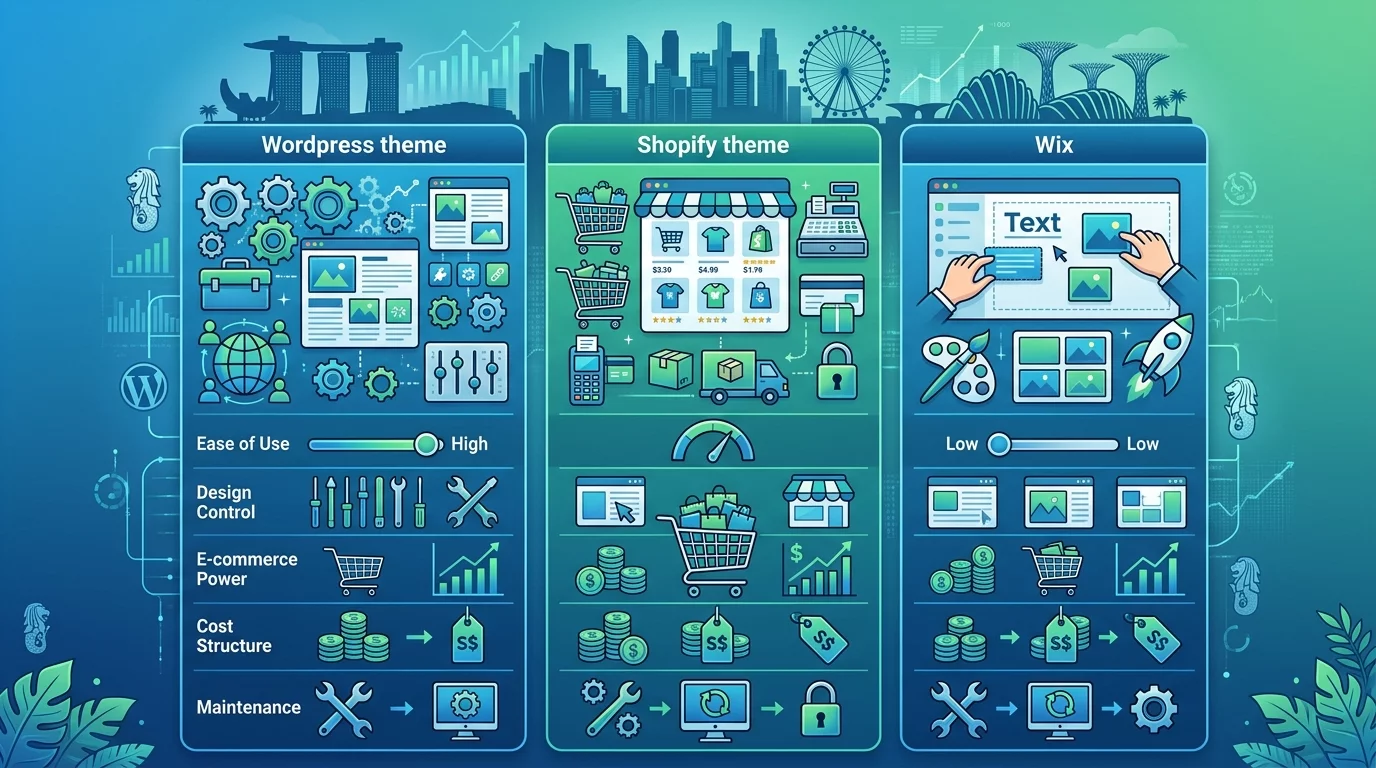
Cost: WordPress is the cheapest in the long run. Shopify and Wix charge monthly fees that add up over time. WordPress only requires domain (around SGD 15 per year) and hosting (SGD 10-30 per month for decent shared hosting).
Ease of Use: Wix wins clearly. Shopify is a close second. WordPress requires the most learning time, especially if you want to manage it yourself.
E-Commerce: Shopify wins for pure e-commerce power. WordPress with WooCommerce is a close second and offers more flexibility. Wix is fine for small stores but not for high-volume selling.
Customisation: WordPress wins without question. You can build literally anything. Shopify and Wix are limited to their templates and available apps.
Maintenance: This is where WordPress loses points for beginners. You are responsible for updates, backups, and security. Shopify and Wix handle all of this for you.
Local Support in Singapore: WordPress has the largest community of local developers and agencies. Shopify also has good support. Wix has fewer local specialists.
Scalability: WordPress scales the best. Shopify scales well for e-commerce. Wix is the most limited when it comes to scaling up significantly.
Making Your Decision: A Simple Framework
Ask yourself these three questions in order:
First, what is the primary purpose of your website? If it is to sell products online, Shopify is your best starting point. If it is to showcase services, share content, or build a brand presence, all three platforms can work, but your choice will depend on your other answers.
Second, what is your technical comfort level? If you are completely non-technical and want the simplest experience, Wix is your answer. If you can invest a few hours learning the basics and want more control, WordPress is achievable. If you want to focus purely on selling without technical distractions, Shopify is designed for you.
Third, what is your growth trajectory? If you anticipate significant scaling, complex requirements, or the need to hire developers later, WordPress gives you the most flexibility. If you plan to stay small and simple, Wix or Shopify will serve you well.
What Singapore Businesses Should Consider That Others Do Not
Singapore has specific requirements that influence this decision. Payment processing is one of the most important. All three platforms can handle international payments, but for local payments, you want to ensure your platform integrates easily with PayNow, NETS, and local payment gateways. Shopify has some advantages here with its app store, but WordPress with WooCommerce also supports local payment gateways with the right setup.
Loading speed matters more in Singapore because mobile usage is extremely high. Your customers are browsing on the MRT, during lunch breaks, and on the go. A slow-loading site loses customers fast. WordPress gives you more control over speed optimisation, but requires more technical knowledge to get right. Shopify and Wix are generally fast out of the box.
Local SEO matters for any Singapore business targeting local customers. All three platforms can be optimised for local search, but the tools and controls vary. WordPress has the most powerful SEO plugins, but Shopify and Wix have built-in features that are easier to use.
If you still need help, feel free to contact us at https://webcare.sg/contact for a free website health check.