Running an online store in Singapore comes with many rewards, but it also comes with one challenge that every e-commerce business owner eventually faces: returns. Whether a customer bought the wrong size shoes, received a damaged product, or simply changed their mind, handling returns properly is one of the most important skills you need to develop as a Singapore online business owner. A well-written returns policy is not just about protecting yourself legally—it is about building trust with your customers and creating a shopping experience that makes people want to buy from you again.
Many small business owners in Singapore treat returns as an afterthought. They either copy a template they found online without understanding it, or they write a very short policy that leaves too many questions unanswered. The result? Customers who are confused, frustrated, or unsure of their rights. That frustration can turn into negative reviews, lost sales, and even legal disputes. On the other hand, a clear, fair, and well-structured returns policy can actually become a selling point for your online store.
In this guide, I will walk you through everything you need to know about writing a returns policy that actually protects your Singapore e-commerce business. I will cover what must be included by law, what you should include to be fair to your customers, how to structure your policy so it is easy to read, and step-by-step instructions for implementing it on your website. This guide is written for complete beginners, so no prior legal or technical knowledge is needed.
Understanding Singapore's Consumer Protection Laws
Before you start writing your returns policy, you need to understand what the law says about consumer rights in Singapore. The Consumer Protection (Fair Trading) Act (CPFTA) is the main law that protects Singapore consumers in their dealings with businesses. Under this Act, a consumer has the right to seek remedies if a product or service does not meet reasonable expectations. This is a broad statement, and it means that as a business owner, you have legal obligations to your customers.
Singapore also aligns with international standards through the United Nations Guidelines on Consumer Protection, which advocate for fair and transparent business practices. While the CPFTA does not mandate a specific returns policy format, it does require that businesses deal fairly with consumers. This means your policy cannot be deceptive, unfair, or misleading in any way.
Under Singapore law, consumers have what is commonly referred to as a "cooling-off period" right when purchasing certain types of goods and services in specific circumstances. However, for general e-commerce retail transactions, the law does not automatically grant a blanket right to return every purchase. This is where your returns policy becomes critical—it fills the gap between what the law requires and what you as a business owner choose to offer.
Key legal requirements you must follow include not making false or misleading claims about your return policy, clearly disclosing any conditions attached to returns, and ensuring that any limitations on returns are communicated before the purchase is made. Failure to comply with these requirements can result in complaints to the Consumer Association of Singapore (CASE) and potential enforcement action by the Small Claims Tribunal or other legal avenues.
Step 1: Decide What Your Return Policy Will Cover
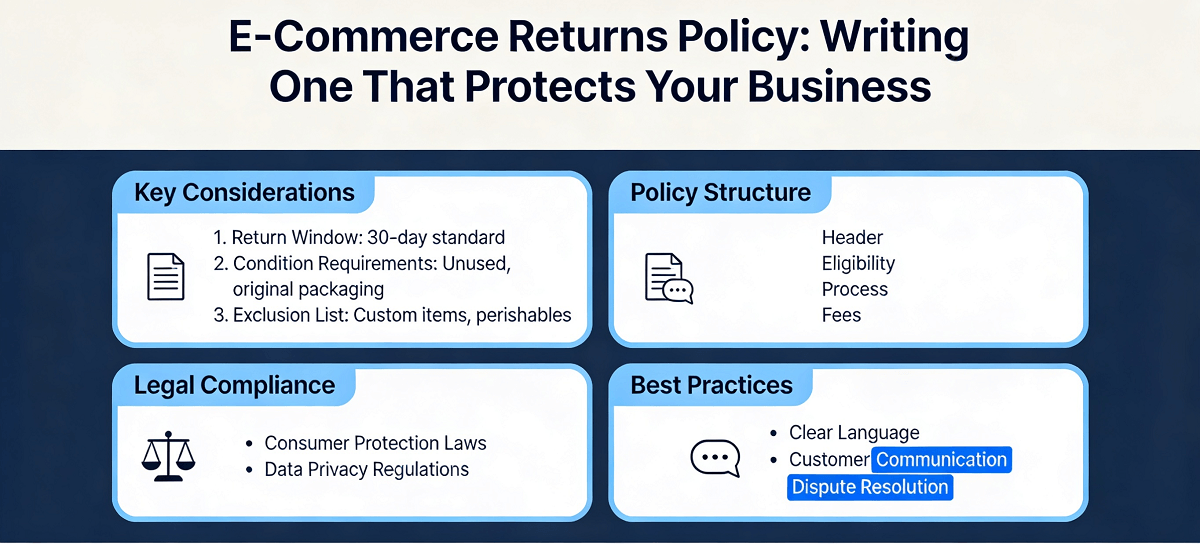
The first and most important step is to decide exactly what your returns policy will cover. This means making clear decisions about several key areas, and then writing those decisions down in plain language. Let me walk you through each decision point.
What types of products can be returned? Not every product category should have the same return rules. For physical goods like clothing, accessories, or electronics, you may want to allow returns within a specific window. For personalized or custom-made items, you might not accept returns at all, and that is perfectly legal as long as you disclose this clearly before purchase. For digital products such as downloadable software, e-books, or digital courses, returns are typically not applicable once the product has been accessed or downloaded.
What condition must the product be in? For returns of physical goods, you need to decide whether you will accept items that have been opened, used, or have tags removed. Many stores accept returns only if the item is in "original condition with tags attached." Others allow opened items but deduct a restocking fee. Be very specific about what condition you will and will not accept, because vague language is one of the most common causes of customer disputes.
How long is your return window? The standard return window in Singapore e-commerce ranges from 7 days to 30 days from the date of delivery or purchase. Some businesses offer 14 days, which is a popular middle-ground choice. You need to pick a timeframe that makes sense for your type of products and your business operations. A 7-day window is common for businesses with limited storage space, while a 30-day window can be used as a competitive advantage to attract more customers.
Who pays for return shipping? This is one of the most contested areas in any returns policy. In Singapore, there are generally three approaches. The first is to offer free returns, where the business covers all shipping costs. This is the most customer-friendly approach and can significantly boost conversion rates. The second is to split the cost, where the business and customer each pay for one direction of shipping. The third is to require the customer to pay for return shipping, which is the least popular but still acceptable if clearly disclosed. You can also choose different approaches for different product categories—for example, free returns for defective items but customer-pays-returns for size exchanges.
Step 2: Define Your Refund Options
Once you have decided what products can be returned and under what conditions, you need to clearly state what happens next—meaning what refund or store credit options are available to the customer. Many business owners overlook this section, leaving customers unsure of what they will receive once their return is processed.
Full refund. This means the customer receives back the full purchase price, including any shipping fees paid for the original delivery. Full refunds are typically offered when the business is at fault—such as when the wrong item was sent, the item arrived damaged, or the item does not match its description. In these cases, it is generally fair practice and often legally expected that you cover all costs.
Partial refund. A partial refund means the customer receives back some portion of the purchase price but not the full amount. Common scenarios for partial refunds include when the item is returned in a used or damaged condition, when tags have been removed, or when the return is requested outside the standard return window but within an extended grace period. Be specific about what percentage or amount will be deducted in each scenario.
Store credit or gift card. Some businesses prefer to offer store credit instead of cash refunds. This can be beneficial for your business because it encourages repeat purchases. However, you should clearly state whether the store credit has an expiration date, whether it can be combined with other promotions, and whether it is transferable to other customers. Under Singapore fair trading laws, any expiry conditions must be clearly disclosed.
Exchange for the same item. For size or colour exchanges, you may offer to replace the returned item with a new one. Specify whether the customer needs to return the original item before the exchange is shipped, whether there are any additional shipping costs for exchanges, and how long the exchange process will take. Many Singapore e-commerce stores offer free exchanges as a way to reduce the friction of online shopping.
Step 3: Identify Exemptions and Special Cases
Every returns policy needs a section clearly listing items and situations that are exempt from the standard return policy. This protects your business and sets clear expectations with your customers. Singapore law requires that any such exemptions be clearly disclosed before the purchase is made, so make sure this section is easy to find on your website.
Non-returnable items typically include:
- Personalized or custom-made items that were created to the customer's specific specifications
- Perishable goods such as food, flowers, or items with a limited shelf life
- Digital products that have been downloaded or accessed, including software, e-books, and digital courses
- Items purchased during final sale or clearance promotions, unless defective
- Intimate apparel, swimwear, or health and personal care items for hygiene reasons
- Items that have been altered, modified, or damaged by the customer after delivery
- Products that were misrepresented by the customer at the time of purchase, such as denying they read the product description
List these items clearly in your returns policy. Use bullet points so customers can quickly scan the list. Avoid technical or legal jargon and write in plain, everyday English so that any customer can understand what is and is not returnable.
Step 4: Write the Actual Policy Document
Now that you have all the building blocks defined, it is time to write the actual policy document. The key principle here is clarity. Your returns policy should be written at a reading level accessible to most adults—it should not read like a legal contract. Customers who can quickly understand your policy are more likely to trust your business and complete their purchase.
Structure your policy with clear headings. Use headings like "How to Initiate a Return," "Return Window and Eligibility," "Condition Requirements," "Refund Options," "Exemptions," and "Contact Information." Each section should be no longer than a few short paragraphs or bullet points. Avoid walls of text that no one will read.
Use plain language. Instead of writing "Items must be returned in their original packaging with all tags affixed and in an unused condition," you could write "Make sure the item has not been used, has all its tags on, and comes back in its original box or packaging." Both sentences convey the same meaning, but the second one is much easier for a regular person to understand.
Be specific about timeframes. Instead of saying "returns must be made within a reasonable time," say "returns must be initiated within 14 days of the delivery date shown on your tracking information." Specificity eliminates ambiguity and prevents disputes.
Include step-by-step instructions for initiating a return. Many customers will not know what to do when they want to return something. Include a numbered list of steps they need to follow. For example:
- Email our returns team at [email protected] within 14 days of receiving your order.
- Include your order number, the reason for return, and photos if the item is defective.
- Wait for our team to reply with a Return Authorization Number and instructions within 2 business days.
- Pack the item securely in its original packaging and attach the return label we send you.
- Drop off the package at any SingPost branch or schedule a pickup.
- Once we receive and inspect the item, we will process your refund within 5 to 7 business days.
Add your contact information. At the end of your returns policy, always include clear contact details. This should include an email address, a phone number if available, and your business address. Singapore customers are more likely to trust a business that provides multiple ways to get in touch.
Step 5: Implement the Policy on Your Website
Writing the policy is only the first part. You also need to make sure it is accessible to your customers at the right moments in their shopping journey. Here is how to do that step by step.
Place the returns policy where customers can find it. The most common and effective placement is in the footer of your website, linked directly from the main navigation menu. Many Singapore e-commerce stores also include a condensed version of their returns policy on the product page itself, near the "Add to Cart" button. This is particularly important for items with special return conditions, such as final sale items or personalized products.
Add a checkbox confirmation during checkout. For higher-value items, consider adding a checkbox at the checkout stage that says something like "I have read and agree to the Returns Policy." This serves two purposes: it ensures the customer has seen the policy, and it provides you with some legal protection if they later claim they were unaware of the return conditions.
Use your e-commerce platform's built-in tools. If you are using Shopify, WooCommerce, Wix, or any other major e-commerce platform in Singapore, these platforms typically have built-in features for managing returns. In Shopify, for example, you can create a dedicated returns page and link it from your store navigation. In WooCommerce, there are plugins available that automate the return request workflow, generate return labels, and track return statuses. Take time to explore these features—they can save you hours of manual work.
Test your returns process yourself. Before launching your store or publishing your updated policy, go through the entire returns process as if you were a customer. Click every link, read every page, and make sure nothing is broken or missing. Ask a friend or family member to also test it and give you feedback on whether the process is clear and logical.
Step 6: Communicate Your Policy to Customers
A returns policy only protects your business if customers actually know about it. Here are some effective ways to communicate your returns policy to Singapore customers.
Order confirmation email. When a customer makes a purchase, send them an order confirmation email that includes a direct link to your returns policy. This is the moment when the policy is most relevant to them, and they are most likely to read it.
Delivery confirmation message. When their order is shipped, include a brief reminder about your returns policy in the shipping confirmation message. Include the return window deadline so customers know exactly how long they have.
Social media and messaging platforms. If you have a presence on Instagram, Facebook, or WhatsApp Business, consider posting about your returns policy periodically. Many Singapore shoppers will check a business's social media before making a purchase, so having clear return information visible there can build trust.
Respond to customer questions promptly. When customers ask about returns on your website's chat, via email, or on social media, respond quickly and reference the relevant section of your policy. This not only helps the individual customer but also builds a knowledge base that can help future customers find answers on their own.
Step 7: Review and Update Your Policy Regularly
Your returns policy should not be a set-it-and-forget-it document. As your business grows, as Singapore consumer laws evolve, and as you learn from customer interactions, you should review and update your policy regularly. Here is how to approach this.
Review your policy at least once a year. Set a calendar reminder to review your returns policy at the same time every year. During the review, ask yourself whether the current policy is working—is there a high volume of returns that suggest a problem with product descriptions or sizing guides? Are customers frequently confused about certain policy points? Are there any new product categories you have added that are not covered by the existing policy?
Keep records of return requests. Maintain a simple spreadsheet or use your e-commerce platform's built-in analytics to track return requests. Record the reason for each return, the product category, and whether the return was approved or denied. Over time, this data will reveal patterns that can help you improve your products, descriptions, and policies.
Stay informed about Singapore consumer law changes. The Consumer Affairs Authority of Singapore (CAA) regularly updates guidelines and enforcement priorities. Sign up for newsletters from CASE or the CAA to stay informed about any changes that might affect your returns policy. Being proactive about legal compliance is always better than being reactive after a complaint has been filed.
Update your policy visibly. Whenever you make changes to your returns policy, clearly communicate those changes to your existing customers. Update the date at the bottom of your policy document to show when it was last revised. If you are making a significant change—such as shortening or lengthening your return window—consider sending an email notification to your recent customers explaining the change and when it takes effect.
Common Mistakes Singapore E-Commerce Owners Make
Before I wrap up, let me highlight some of the most common mistakes I see Singapore e-commerce business owners make with their returns policies. Avoiding these mistakes will save you time, money, and customer disputes.
Copying someone else's policy without adapting it. Every business has different products, suppliers, and operational capabilities. A policy that works for a large marketplace with a warehouse may not work for a small home-based business that ships items individually. Customize your policy to reflect your actual business operations. If your policy says things you cannot actually deliver, you will face problems.
Hiding the returns policy in fine print. If your returns policy is buried in a wall of text, hidden behind a tiny link, or written in extremely small font, customers will feel deceived if they try to use it and discover it does not work the way they expected. This damages trust and can lead to complaints to CASE. Make your policy visible, accessible, and easy to read.
Not being specific about timelines. Phrases like "returns accepted within a reasonable time" or "refunds processed shortly after receipt" are too vague. Always use specific dates and timeframes. "Returns accepted within 14 days of delivery" and "refunds processed within 7 business days of receiving your returned item" are much better.
Promising things you cannot deliver. If you say you offer free returns but then do not have a process in place to honour that promise, you will face customer complaints and potential legal action. Only promise what you can actually deliver, and then make sure your operations are set up to deliver it consistently.
Not training your staff. Even if you have a perfect returns policy on paper, it is useless if your customer service team does not know how to implement it. Train anyone who handles customer inquiries on your returns policy, and make sure they have the authority to process returns within the guidelines you have set without requiring management approval for every single request.
Writing a returns policy for your Singapore e-commerce business does not have to be complicated or intimidating. By following the step-by-step approach in this guide, you can create a policy that protects your business, builds trust with your customers, and complies with Singapore consumer protection laws. Start by making the key decisions about what is covered and what is not, write the policy in plain language, make it easy to find on your website, and commit to reviewing it regularly as your business grows.
If you still need help, feel free to contact us at https://webcare.sg/contact for a free website health check.