When Google announced the sunset of Google Optimize in September 2023, many Singapore business owners felt a sudden panic. If you had been using Google's free A/B testing tool to improve your website's conversion rates, you suddenly found yourself without a vital instrument in your digital marketing toolkit. This guide will walk you through exactly what happened, why it matters for your Singapore business, and most importantly, how you can continue running A/B tests using excellent alternatives that are available right now. By the end of this guide, you will have a clear roadmap to keep improving your website's performance without spending a fortune on enterprise tools.
First, let us understand why Google Optimize mattered so much to small businesses in Singapore. Before its sunset, Google Optimize allowed business owners to test different versions of their web pages without needing any coding knowledge. You could show one version of your landing page to half your visitors and a different version to the other half, then measure which version generated more enquiries, more sales, or more newsletter sign-ups. For a Singaporean SME operating on tight marketing budgets, this ability to make data-driven decisions about your website was incredibly valuable. You were no longer guessing what works — you were testing and letting the data tell you what your customers respond to best.
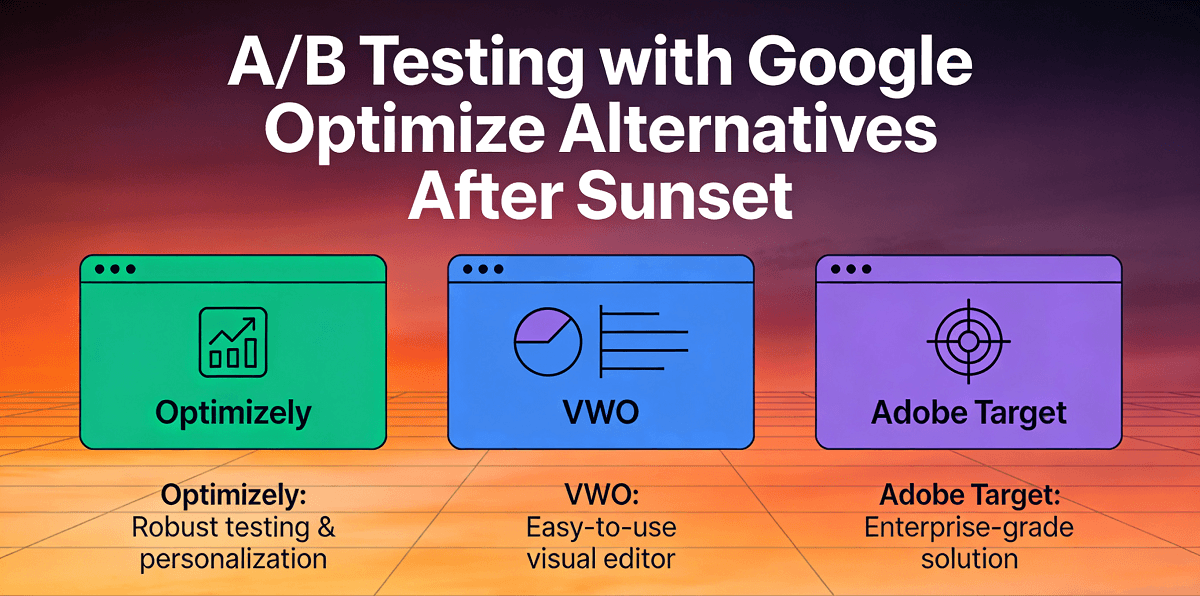
The sunset of Google Optimize left a genuine gap in the market for free or low-cost A/B testing tools that non-technical business owners could use. While enterprise solutions like Optimizely and VWO offer powerful features, their price tags put them out of reach for most Singapore small businesses. Fortunately, several quality alternatives have stepped up to fill this void. In this guide, we will walk through three practical options that work well for Singapore business owners: Google Analytics 4 experiments, Convert, and Adobe Target's free tier. We will also cover the key concepts you need to understand before running your first A/B test, because running tests without this foundational knowledge can actually hurt your business by leading you to incorrect conclusions.
Understanding the Core Concepts Before You Start Testing
Before you spend any money on testing tools or run any experiments on your website, you need to understand a few fundamental concepts about A/B testing. Many Singapore business owners jump into testing without this knowledge and end up wasting time and money on tests that give misleading results.
The first concept is statistical significance. When you run an A/B test, you are trying to determine whether the difference in performance between version A and version B is real or just due to random chance. Statistical significance tells you how confident you can be that the difference is genuine. In practical terms, you should aim for at least 95% statistical significance before making a business decision based on your test results. What does this mean in plain English? It means that if you run a test and see that version B is performing better than version A, you want to be at least 95% sure that this improvement is real and not just a lucky accident. Running tests to lower significance levels often leads to costly mistakes where you implement changes that do not actually help your business.
The second concept is sample size. A/B tests require a certain number of visitors before they can produce reliable results. If your website only gets 50 visitors per day, you may need to run a test for several weeks or even months before you have enough data to draw conclusions. Many business owners make the mistake of checking their test results after just a few days and then jumping to conclusions. This is premature and can lead to implementing changes that appear to work in the short term but fail in the long term. Use an online A/B test sample size calculator to determine how long you need to run your test before you can trust the results.
The third concept is test isolation. The more changes you make between your control version and your variant version, the harder it is to understand what actually caused any difference in performance. If you change the headline, the button color, the form length, and the page layout all at once, and version B performs better, you still do not know which of those four changes made the difference. For your first several tests, try to make only one change at a time. This discipline will teach you more about what resonates with your audience than any complex multivariate test ever could.
Step 1: Choose the Right Tool for Your Singapore Business
The tool you choose for A/B testing should match your technical comfort level, your budget, and the amount of traffic your website receives. Let us look at three practical options that work well for Singapore businesses.
If you already use Google Analytics 4 on your website, you have access to built-in experimentation features that can serve as a direct replacement for Google Optimize. GA4 allows you to create experiments directly within the platform, run A/B tests on your web pages, and analyze the results alongside your other analytics data. This integration is valuable because you can see how your test results connect to your broader traffic and conversion patterns. To access this feature in GA4, navigate to the Configure section and look for Experiments. You can run up to three simultaneous experiments, which is sufficient for most small business needs. The main limitation is that GA4's experimentation tool has a more technical interface than Google Optimize had, so you may need to spend some time learning the interface before you feel comfortable.
Convert is an excellent alternative that specifically targets small and medium businesses with an affordable pricing model. Convert offers a free trial and then plans starting at a reasonable monthly rate that include everything you need to run professional A/B tests. What sets Convert apart is its focus on ease of use. The visual editor allows you to make changes to your web pages by clicking on elements and modifying them directly, without needing to write any code. This is particularly valuable for Singapore business owners who are not comfortable with HTML or CSS. Convert also provides robust statistical analysis tools that automatically calculate when you have reached statistical significance, removing much of the guesswork from the process.
For businesses with slightly larger budgets, Adobe Target offers a free tier that includes powerful personalization and testing features. Adobe Target is an enterprise-grade solution, so the free tier does come with some limitations, but it is still more feature-rich than many paid alternatives. The platform uses AI to help you create test variations and automatically allocates traffic to the best-performing variations as your test runs. This machine learning capability can significantly reduce the time required to get meaningful results from your tests, though it does require some technical setup that may necessitate help from someone with web development experience.
Step 2: Define Clear Goals for Your A/B Test
Every A/B test should start with a clear, measurable goal. Without a specific goal, you cannot determine whether your test was successful or what you learned from it. For a Singapore business owner, your goal will typically relate to a business outcome such as increasing quote requests, boosting phone calls to your business, growing newsletter sign-ups, or driving more sales through your online store.
When defining your goal, be as specific as possible. Instead of saying "I want more enquiries," say "I want to increase the number of quote request form submissions from my contact page by at least 20%." This specificity matters because it guides every decision you make throughout the testing process. It tells you which metric to measure, how long to run your test, and how to interpret your results. A vague goal like "more enquiries" can lead you to celebrate a test result that was actually just random noise in your data.
Write down your goal before you create your test variations. This simple discipline prevents scope creep where you gradually expand what you are trying to achieve mid-test, which invalidates your results. Once you have defined your goal, identify the specific metric you will use to measure progress toward that goal. This metric is called your primary KPI, or Key Performance Indicator. All other metrics you track during the test are secondary KPIs, useful for gaining additional insights but not the basis for your decision about whether the test was successful.
Step 3: Create Your Test Variations
With your goal clearly defined, you can now create the variations of your web page that you will test against each other. Remember our earlier advice about test isolation: for your first several tests, focus on making just one change per test. This single change might be your headline, your call-to-action button text, your button color, your form length, your hero image, or your page layout. Choose the change based on where you believe there is the most room for improvement on your page.
When deciding which element to test first, look at your website's analytics to identify pages with high traffic but low conversion rates. These pages represent the biggest opportunities for improvement. If your contact page gets 200 visitors per month but only 10 submit the form, improving that conversion rate could significantly impact your business without requiring more traffic. The math is straightforward: a small percentage improvement on a high-traffic page delivers more value than a large percentage improvement on a low-traffic page.
For each variation you create, write a clear hypothesis. A good hypothesis follows this structure: "If we change [specific element] from [current state] to [new state], then [specific metric] will improve by [expected amount] because [your reasoning]." For example: "If we change the headline on our contact page from 'Get in Touch' to 'Request a Free Quote Today,' then the form submission rate will increase by at least 15% because the new headline communicates a specific benefit and creates urgency." This hypothesis format keeps your tests focused and gives you a clear benchmark for success.
Step 4: Run Your Test with the Correct Duration
One of the most common mistakes Singapore business owners make with A/B testing is stopping a test too early. They check their results after a few days, see that one variation is ahead, and immediately implement it. This approach is flawed because short-term results often reverse themselves over time. A variation that appears to be winning after three days might fall behind after two weeks due to normal fluctuations in visitor behavior patterns.
Use a sample size calculator before you start your test to determine how many visitors and how many conversions you need to reach statistical significance. Most online calculators are free and take just a few minutes to use. Input your current conversion rate, your minimum detectable effect (the smallest improvement you want to be able to detect), your desired statistical significance level (use 95%), and your traffic allocation percentage. The calculator will tell you how many conversions you need and approximately how long you should run your test.
As a general rule, most small business websites with reasonable traffic should run A/B tests for a minimum of two weeks. This duration helps account for variations in visitor behavior by day of week and time of month. If your business has seasonal patterns, you may need to run tests longer to capture enough data across your full business cycle. Patience is essential here. The value of A/B testing comes from making well-informed decisions based on reliable data, not from making quick changes based on incomplete information.
Step 5: Analyze Results and Implement Winning Variations
Once your test has run for the predetermined duration and reached statistical significance, you can analyze your results. Look at your primary KPI first. Did the variation you tested outperform the control? If yes, by how much, and was the difference statistically significant? If the difference is statistically significant and practically meaningful for your business, you have a clear winner.
Do not make the mistake of looking at secondary KPIs to find a story that contradicts your primary KPI result. If your primary KPI shows that form submissions increased but page views decreased, focus on the form submissions because that was your stated goal. Secondary metrics are for generating insights for future tests, not for overriding your primary metric's verdict.
When you have a clear winner, implement it on your website and then move on to your next test. A/B testing is a continuous process of improvement, not a one-time activity. The businesses that get the most value from A/B testing are those that treat it as an ongoing practice embedded in their regular marketing operations. After implementing your winning variation, document what you learned and plan your next test based on those learnings.
If your test shows no statistically significant difference between the control and the variation, that is also valuable information. It tells you that this particular change is unlikely to move the needle for your business, so you can move on to testing a different element. Many tests will be "no difference" results, and this is normal and expected. The cumulative knowledge you gain from multiple tests teaches you more about your customers than any single test ever could.
Common A/B Testing Mistakes to Avoid in Singapore
Singapore business owners often fall into several common traps when they first start A/B testing. Understanding these pitfalls before you begin will save you time, money, and frustration.
The first mistake is testing too many variations at once. While it might seem efficient to test five different headlines simultaneously, this approach requires significantly more traffic to reach statistical significance for each comparison. With a small or medium traffic website, testing many variations can mean running tests for months before getting reliable results. Stick to testing one variation against your control until you have enough traffic to support more complex tests.
The second mistake is ignoring mobile visitors. Singapore has one of the highest smartphone penetration rates in the world, and a significant portion of your visitors are likely browsing on their phones. Make sure your testing tool captures mobile visitor data separately and consider running mobile-specific tests to optimize the experience for your mobile audience. A change that improves desktop conversions might actually hurt mobile conversions, so treating them as separate test audiences is wise.
The third mistake is not accounting for external factors. If you run a test during the year-end holiday period, your results will be influenced by seasonal shopping patterns that may not reflect normal business conditions. Similarly, if Singapore enters a new phase of COVID-19 restrictions or experiences unusual weather events, these external factors can skew your results. Note any external events that occur during your test period and factor them into your analysis.
If you still need help, feel free to contact us at https://webcare.sg/contact for a free website health check.