In the world of website optimization, there's a common dilemma: how much time and effort should you spend on improving website speed versus traditional SEO tactics? The truth is, they are no longer separate concerns. Google has made it clear that website performance—especially Core Web Vitals—is a crucial ranking factor. However, not all speed fixes are created equal. Some require a significant amount of effort for a minimal gain, while others can provide a huge boost with very little work. This guide will provide a practical framework for prioritizing your speed fixes to get the biggest SEO and user experience gains. It's an essential part of a comprehensive website audit.
The Impact of Speed on SEO
Google's algorithms now use page speed and user experience signals to determine search rankings. A slow-loading website not only frustrates users, leading to a high bounce rate, but it also signals to Google that your site might not be a good user experience. This can directly impact your rankings. Speed-related issues are one of the most common website errors that can negatively affect your SEO. For a deeper look at the metrics, see our guide on improving Core Web Vitals.
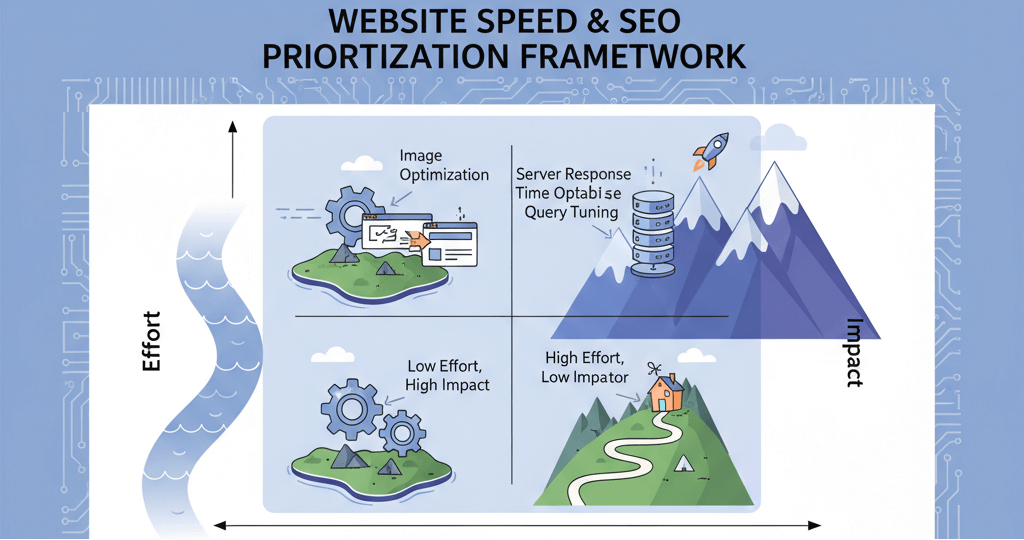
A Practical Framework: Effort vs. Impact
To avoid getting overwhelmed, use a simple framework to prioritize your fixes. Categorize each potential fix by its level of effort and its potential impact on your Core Web Vitals and overall performance. Focus on the low-effort, high-impact changes first, and then move on to the more complex ones. The goal is to get the best return on your time and resources.
High-Impact, Low-Effort Fixes
These are the low-hanging fruit—changes that can provide a huge boost to your speed with minimal technical work. Tackle these first to see immediate results.
- Image Optimization: Large, uncompressed images are the number one cause of slow websites. Use a plugin or online tool to compress your images and use modern formats like WebP. This simple step can shave seconds off your page load time. For a detailed guide, see our article on Optimizing Website Images Without Sacrificing Quality.
- Leverage Browser Caching: Configure your server to tell a user's browser to store static files (like CSS, JavaScript, and images) for a certain period. This means that when a user returns to your site, their browser doesn't have to re-download these files, leading to a much faster experience.
- Enable Lazy Loading: Implement lazy loading for images and videos that are "below the fold." This prevents them from loading until the user scrolls down, improving the initial load time and LCP score.
Medium-Impact, Medium-Effort Fixes
These changes require a bit more technical expertise but can provide a solid boost to your website's performance. They are worth the time once you've completed the easy fixes.
- Minify CSS and JavaScript: Minification removes unnecessary characters from your code without changing its functionality. This reduces file size and improves loading speed.
- Reduce Redirects: Redirects add an extra step to the page loading process. Use a tool to find and fix any unnecessary redirects on your site. For more on this, see our guide on How to Fix Infinite Redirect Loops.
- Improve Server Response Time: A slow server is a bottleneck for everything. A professional can help you troubleshoot and optimize your server. You can also upgrade your hosting plan or use a Content Delivery Network (CDN) to serve your content faster. Our Server Maintenance Checklist provides more information.
High-Impact, High-Effort Fixes
These are the most complex and time-consuming fixes. While they can provide the biggest gains, they often require a developer's expertise and a deeper understanding of your website's code. You should only tackle these once you've exhausted all other options.
- Optimize Your Critical Rendering Path: This involves prioritizing the loading of the content that is immediately visible to the user. This often requires restructuring your code to load essential CSS and JavaScript first.
- Switch to a Faster Hosting Provider: While it may seem simple, switching hosts can be a complex process that, if done improperly, can lead to downtime. However, it can provide a substantial performance boost if your current host is a bottleneck. For more on this, check out our guide on How to Fix Slow Website Performance.
When to Call the Experts
While many of these fixes are practical for a DIY approach, some are more complex. If you've tried the easy fixes and are still struggling, or if your website is built on a complex platform, a professional can help. A professional can quickly diagnose complex issues and implement fixes without the risk of breaking your site, a common problem with DIY website fixes. They can ensure your website is not only fast but also secure and fully optimized for search engines.
If you’re still having trouble, don’t worry! WebCare SG is here to help. Contact us today for fast and reliable website fixes.